
A close look at President Trump’s collapse of approval ratings among bellwether voting groups that helped carry him to victory and where they stand today.
by Jeremy Zogby, Managing Partner
Donald Trump’s 2024 win was narrow in the popular vote, but decisive and sweeping as he took all battleground states. As the exit polls came in, it became clear his winning coalition went well beyond his 2016 victory, with stronger support from diverse voting blocs, including those under 30 years of age (particularly men), Hispanics, Blacks, parents with a child living at home, first-time voters, union voters, and more. For many of these cohorts, the President’s approval ratings generally held strong during his first 100 days.
From May 2025 to March 2026, John Zogby Strategies has launched 9 waves of national polls targeting likely voters in the 2028 general election. Below, we’re showing the first wave of polling among likely voters from late May 2025 and the most recent from March 18, 2026. Here, we chart approval/disapproval ratings of the President’s job performance among key voting blocs, given both their importance in election turnout and their significance as bellwether groups.
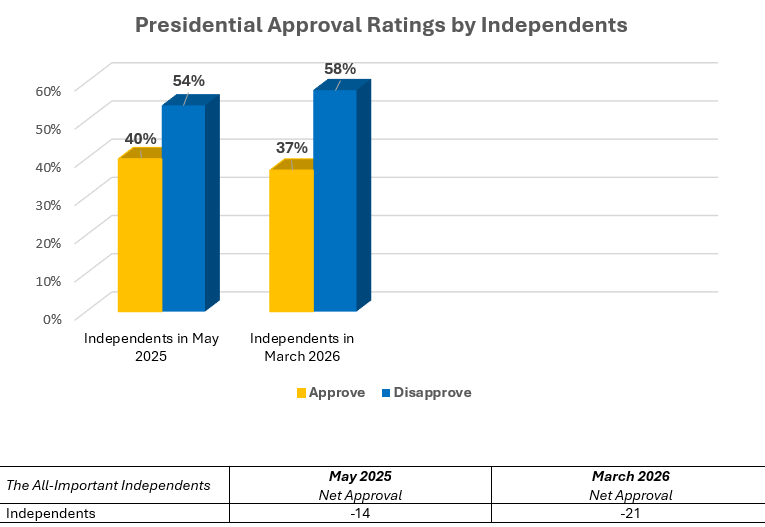
According to 2024 exit polling, 34% of the electorate identified as independent on Election Day, outnumbering Democrats – a very rare occurrence in modern electoral history. Moreover, our polling over the years shows that a plurality of independent voters have voted for both Democratic and Republican candidates, which makes this group a wild card and why they’re so important to track and understand.
According to the chart above, we can see that, following President Trump’s first 100 days in office, independent voters were already decisively turning away from the President. And that trend has solidified. The question remains: can Republicans regain enough independent voters as we head towards the midterms? I can’t think of an example in modern polling when a political figure went so far into negative territory with a key group and managed to recover a significant percentage.
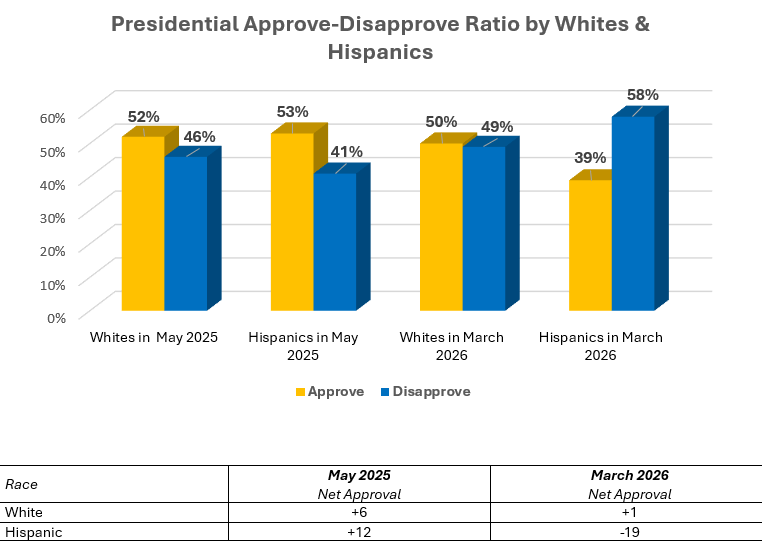
While more white voters still approve of the President than disapprove, he is only net positive 1 percentage point among his typical base and the nation’s largest voting bloc. That is the first major indicator flashing red for the President when looking at race demographics.
Equally important is the collapse of support from Hispanic voters who helped to carry the President to a sweeping victory in November of 2024. Less than a year ago, Trump was double-digit net positive with this growing and increasingly important voting bloc; today, the President finds himself underwater by nearly 20 percentage points.
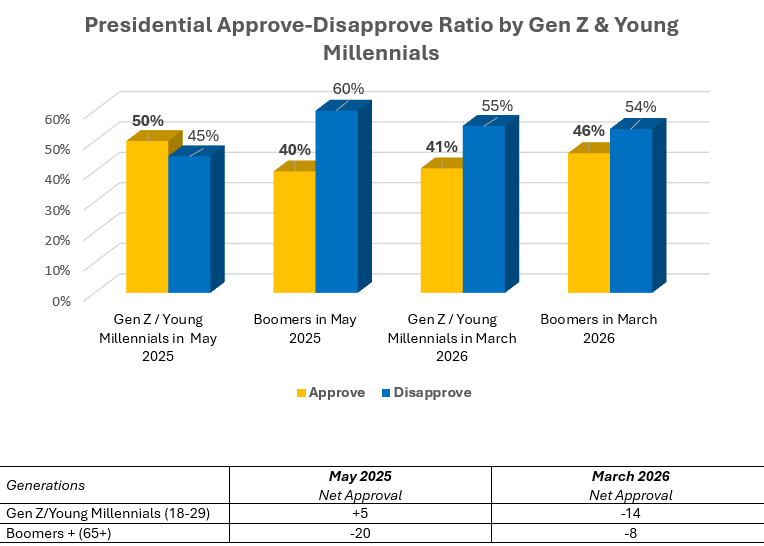
Although Donald Trump barely won the under-30 vote in November, it was still surprising to many, given how this cohort voted in 2020 (largely for Biden). In 2024, while the gender gap was enormous between how men and women under 30 voted, the President turned out more young men than young women. For a while during his presidency, Trump had net-positive approval ratings among the under-30 vote. They were with Trump because of the expectations that he’d kickstart an economy hit by inflation, and because a negative outlook had increasingly paralyzed young voters throughout the Biden Presidency. Then, within just a few months into the Trump Presidency, came tariff wars, an explosive re-emergence of the Epstein files, Venezuela, and a major escalation of war with Iran in a geostrategic area that holds the key to modern life and the global economy. Today, the President is significantly underwater with young voters. As is typically the case with this cohort during the Midterms, they will play a significant role by either turning out or staying home. In either case, they have moved away from the President, and may be unreachable according to the data. Meanwhile, for baby boomers, the opposite has happened. In part 2, we’ll chart older millennials and Gen X.
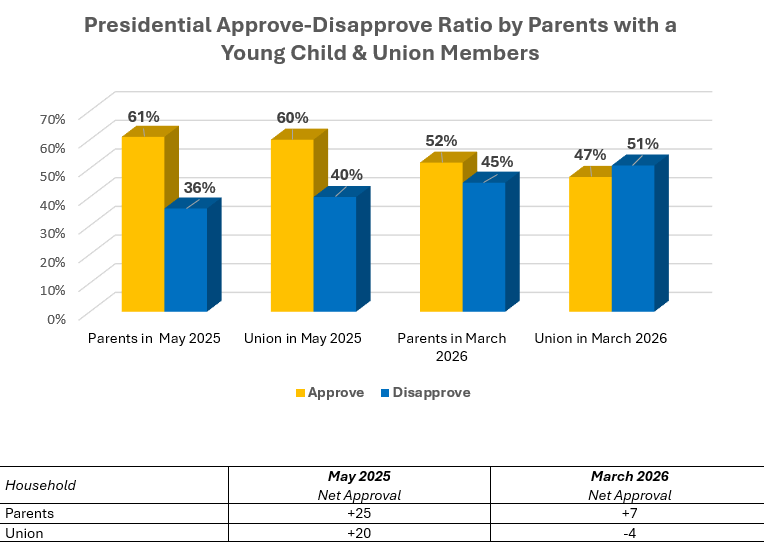
Parents and union voters made a decisive break with the Democratic Party in 2024, aligning themselves with President Trump throughout his 100 days and into the summer. Both groups, driven by deep concerns about work, the cost of living, raising children, etc., strongly supported Trump. While parents generally still approve of the President’s job in the White House, they’ve fallen significantly. The same is basically true among Union voters, though note the President is now underwater with them.
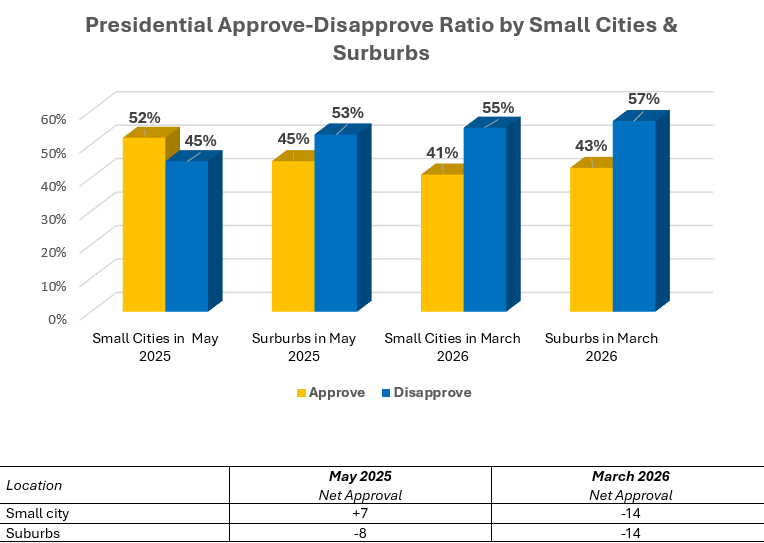
While the President didn’t have strong support among suburban voters by May of 2025, he did have strong ratings from voters in small cities – perhaps seeing themselves as an extension of the so-called forgotten America, looking to the President to strengthen the economy and bring back factories. As of today, that is no longer the case, as they’ve made it clear that a strong majority disapproves of Trump’s job performance.
In the final analysis, there are still seven months until the Midterm Elections. But a little over one year into a Presidency that continues to generate controversy and bold actions, coinciding with the brevity of collapse among decisive voting blocs, raises serious concerns about how President Trump can rally Republicans to victory come November.
In Part 2, we’ll look at men, women, veterans, Evangelicals, Catholics, and beyond.
